



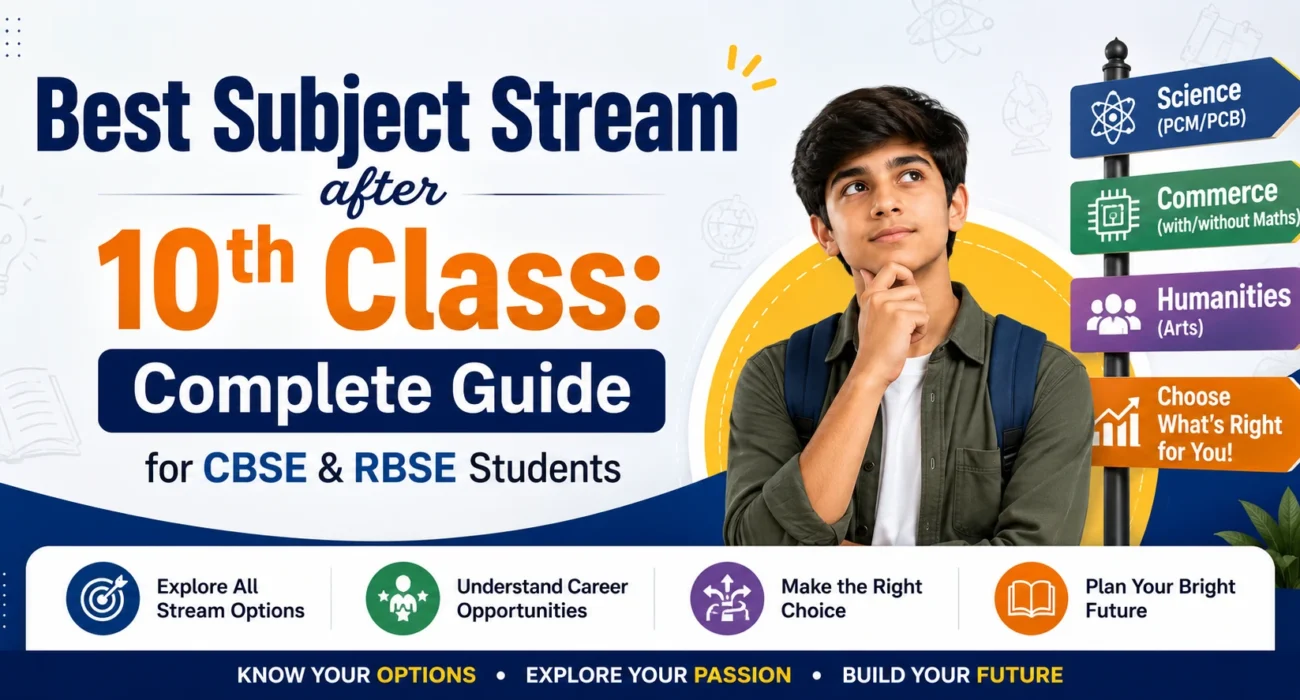
Best Subject Stream after 10th Class: Complete Guide for CBSE & RBSE Students
Passing your Class 10 board exams is a huge milestone. At the same time, it brings one of the most important academic decisions for your future. Every student faces the same important decision: Which stream is best after 10th? For English medium students under the CBSE or Rajasthan Board (RBSE), this choice is not just about the next two years. The stream you choose after Class 10 affects your future studies, career options, and long-term growth. Many students feel confused because of family pressure, friends’ advice, and too much mixed information online. If you are staring at admission forms, wondering which stream is best after 10th class, this complete guide is for you. It is specially designed for students looking for clear career guidance after 10th in India. In this guide, you will understand:- Which Stream is Best after 10th? The Big Three Breakdown
- The Science Stream – For Innovators, Problem Solvers & Researchers
- The Commerce Stream – For Financial Minds, Strategists & Entrepreneurs
- The Arts & Humanities Stream – For Creative Thinkers, Communicators & Administrators
- The Vocational & Polytech Route – Alternative Tracks after Class 10
- How to Choose Which Stream is Best for Your Future after 10th
- CBSE vs RBSE: Which Board Helps Better Stream Selection?
- Common Mistakes to Avoid During Subject Selection after 10th Class
- Frequently Asked Questions (FAQs)
- Conclusion: Take Action on Your Future Today
Get Expert Career Guidance for Medical Admissions in India & Abroad
- Expert guidance as per your NEET score & career goals
- Explore top colleges in India and leading universities abroad
- Complete understanding of admission procedures, documentation & visa process
- Direct consultation with experts – 100% secure, no third parties involved
Which Stream is Best after 10th? The Big Three Breakdown
To choose the right stream after 10th, it is important to move beyond common myths and outdated beliefs. No stream is superior. Every stream is suitable for different interests, strengths, and future career plans. Let us understand each stream in detail.1. The Science Stream – For Innovators, Problem Solvers & Researchers
Science is a good option for students who enjoy logic, problem-solving, and practical learning. If you enjoy understanding how things work, solving numerical problems, and learning through practical concepts, Science can be a good choice.Core Subject Groupings under Science
The Science stream is divided into two primary academic tracks across the Indian boards:PCM (Non-Medical) Track
This combination includes Physics, Chemistry, Mathematics, and English. This subject combination helps students build a strong foundation for engineering, architecture, and other technical fields.PCB (Medical) Track
This combination includes Physics, Chemistry, Biology, and English. This stream is best for students who want careers in medicine, healthcare, and life sciences.PCMB (General Science) Option
A core combination of both Mathematics and Biology. This option offers more career choices later, but students need to manage a heavier study workload.New-Age Skill Electives
Advanced choices include Informatics Practices (IP), Computer Science, Artificial Intelligence, or Physical Education.How to Know if Science is Right for You
Do not choose Science simply because you scored above 90% in Class 10. The level of Science in Class 11 is much more advanced compared to Class 10th. Science may be the right choice for you if:- You like understanding concepts instead of only memorizing answers.
- You are ready to study regularly and stay consistent with practice.
- If you want to keep multiple career options open for the future, Science can be beneficial.
Best Future Options in Science after 10th
Top Career Options through PCM
Engineering (IITs, NITs, and top global tech branches via JEE Mains & Advanced), Commercial Aviation (Pilot), Architecture, Data Science, Aerospace Engineering, Defence Services (via the NDA exam), and Quantum Computing.Top Career Options through PCB
Medical Practitioner (MBBS, BDS, or AYUSH via NEET-UG), Pharmacy (B.Pharma), Biotechnology Engineering, Veterinary Sciences, Forensic Science Investigation, and Genetics Research.2. The Commerce Stream – For Financial Minds, Strategists & Entrepreneurs
Commerce helps students understand business, money management, and how companies work. If you are interested in business, finance, or understanding how companies grow, Commerce can be the right option.Core Subject Groupings under Commerce
Accountancy
Accountancy is the foundation of business and finance. You learn how to manage financial records, understand taxation, and analyze business accounts.Business Studies
This paper covers how companies organize, manage human resources, scale operations, implement marketing strategies, and execute corporate management.Economics
Economics helps you understand how markets and money systems work. You learn how markets work, how prices change, and how economic decisions affect businesses and people.The Mathematics Dilemma: Core vs Applied
You can opt for Commerce with Maths (Core/Applied) or Commerce without Maths (replacing it with Entrepreneurship or Physical Education). If possible, choose Maths with Commerce for better career options later.How to Know if Commerce is Right for You
- Commerce is a good choice if you enjoy numbers, analysis, and practical problem-solving.
- You enjoy solving practical business-related problems more than studying scientific theories and lab-based concepts.
- You dream of launching a startup, managing corporate wealth, or leading an MNC as a corporate executive.
High-Paying Career Fields in Commerce
- Chartered Accountancy (CA) or Company Secretary (CS).
- Investment Banking, Portfolio Management, and Stock Market Broking.
- Actuarial Science (High-paying risk calculation and insurance data roles).
- Corporate Management (pursuing a BBA or IPM integrated degree followed by an MBA at top IIMs).
- Corporate Law (handling mergers and acquisitions via a 5-year integrated BA-LLB or BBA-LLB).
3. The Arts & Humanities Stream – For Creative Thinkers, Communicators & Administrators
Arts is no longer considered a limited career option. Today, it offers excellent opportunities in government services, law, media, design, and communication fields across India.Core Subject Groupings under Arts
Arts gives students flexible subject choices. You can select 4 to 5 subjects based on your evolving interests:Political Science
Explores global governance, international relations, constitutional frameworks, public policy, and administrative structures.History
This subject helps students understand historical events, ancient civilizations, and how societies have developed over time.Geography
Studies spatial science, climate patterns, human topography, geopolitics, and natural resource distribution.Psychology & Sociology
These subjects help students understand human behavior, emotions, society, and social relationships.Economics
Can be combined with humanities to build a strong academic base for public policy and international trade careers.How to Know if Arts is Right for You
- You are an avid reader, express ideas clearly through writing, and enjoy critical debates.
- Your long-term vision involves governance, social impact, psychological analysis, or creative expression.
- You prefer deep, qualitative analysis and human case studies over rigid scientific formulas.
High-Paying Career Fields in Arts
- Civil Services: Becoming an IAS, IPS, or IFS officer. The official UPSC Civil Services exam syllabus overlaps with core Arts subjects by more than 60%.
- Judiciary & Legal Track: Becoming a litigation lawyer, corporate counsel, or legal advisor via the CLAT entrance exam.
- Media & Communications: Journalism, Public Relations (PR) management, Advertising, and digital Content Strategy.
- Design & Creative Arts: Product Design, UX/UI Design, Fashion Communication, and Fine Arts management.
4. The Vocational & Polytech Route – Alternative Tracks after Class 10
If regular academic streams do not suit you, skill-based diploma courses can be a smart option. This route helps students start practical career training early.Skill-Based Diplomas & Industrial Training Institutes (ITI)
- Engineering Diplomas: 3-year Polytechnic programs in Mechanical, Civil, Electrical, or Computer Engineering allow direct lateral entry into the second year of a B.Tech degree.
- ITI Trades: Short-term certificates in Electrical work, HVAC maintenance, Digital Drafting, and Precision Machining.
- New-Age Vocational Electives: Direct training tracks in Travel & Tourism management, Hospitality operations, Web Development, and Digital Photography.
Pros and Cons of Alternative Tracks
- The Advantages: These courses cost less and focus more on practical skills.
- The Disadvantages: Limited early administrative growth, lower starting pay than premium university degrees, and intense local labor market competition.
How to Choose Which Stream is Best for Your Future after 10th
Selecting the right stream requires careful thinking and honest self-evaluation. Do not make this decision only because of friends, family pressure, or current trends. Use this three-step framework to secure an ideal academic choice.1. Analyze Your Aptitude vs Your Interest
Liking a subject is different from being naturally good at it, so both interest and ability should be considered.- List the subjects you score high in consistently.
- Balance those grades against the subjects you genuinely enjoy studying daily.
- Pick a stream that matches your strengths and academic interests.
2. Identify Your Long-Term Career Goals Early
Think about the career you want in the future. If you already know your future career goal, choose a stream that supports that path from the beginning. If your goal is top law careers, building early communication skills via Arts or Commerce with Mathematics gives you a competitive edge.3. Take a Certified Psychometric Assessment Test
Sometimes students cannot judge their strengths correctly. A psychometric test helps students understand their strengths, learning style, and suitable career direction. It helps identify which stream matches your natural strengths and learning style.CBSE vs RBSE: Which Board Helps Better Stream Selection?
Your school board can affect how deeply subjects are taught and how well you prepare for entrance exams.Central Board of Secondary Education (CBSE) Dynamics
- Syllabus Uniformity: Follows the national NCERT blueprint. This aligns directly with pan-India national entrance exams like JEE, NEET, and CUET.
- Applied Learning: Emphasizes deep, continuous internal evaluation, continuous practical assessments, and objective-type questioning formats.
- Global Portability: Better acceptance for higher education opportunities in India and abroad.
Board of Secondary Education, Rajasthan (RBSE) Dynamics
- Strong Theoretical Learning: RBSE focuses more on detailed theory-based concepts, helping students build strong writing and memory skills.
- State-Level Advantage: Provides an edge for Rajasthan-specific government administrative vacancies, state engineering seats, and local university quotas.
- Affordable Accessibility: Offers highly cost-effective public schooling resources and structured state-backed study text distributions.
Common Mistakes to Avoid During Subject Selection after 10th Class
1. Following Your Friends Blindly
Choosing a difficult academic stream simply to stay in the same classroom as your close friends is a major mistake. Classes 11th and 12th require deep personal focus. Peer choices will not save your grade point average if you struggle with the core topics.2. Yielding to Outdated Parental Pressure
Your parents want security, but sometimes parents guide students based on career options that were more popular in earlier times. Talk to your parents using real career examples and current opportunities. Show them how alternative routes offer stable paths to professional success.3. The 90% Marks Trap
Scoring a 95% in Class 10 Science does not automatically guarantee you will excel in Class 11 PCM. Class 10 general science uses simple, descriptive overviews. Class 11 is more detailed and needs a deeper understanding than Class 10.4. Ignoring New-Age Career Landscapes
Do not limit your outlook to just Engineering or Medicine. Today, students can also build successful careers in digital marketing, product management, app development, and data analytics.Frequently Asked Questions (FAQs)
Which stream is best after 10th for high-paying jobs?
All three streams lead to high-paying jobs. PCM leads to Data Science, Software Architecture, and Commercial Aviation. Commerce produces high-earning Investment Bankers, Corporate Attorneys, and CAs. Arts creates valuable pipelines for Corporate Counsel, Civil Servants, and Creative Directors. Your focus and skill matter more than the stream title.Can I change my subject stream in Class 11 if I find it too difficult?
Yes, most schools under CBSE and RBSE allow limited track alterations during the first three months of Class 11. However, making changes after the official board registration forms are submitted is difficult and can delay your academic timeline.Is it possible to pursue corporate law after choosing the Science stream?
Yes. National law universities select candidates based on the common CLAT entrance test. Your specific Class 12 stream does not restrict your eligibility. Science and Commerce students can also get admission to top law colleges.What are the main benefits of choosing Commerce over Science?
Commerce gives students a direct understanding of business, finance, and management concepts. The workload balances practical mathematics with operational strategy, leaving out abstract laboratory experiments. It provides a direct path to entrepreneurship and wealth management.Can RBSE students choose Science after scoring below 75%?
Yes, RBSE students can choose Science after scoring below 75%, but eligibility depends on the specific school’s admission criteria. Some schools require higher percentages for Science admission, while others evaluate overall academic performance and subject-wise marks. Students should consult their preferred school directly before making a decision.Why Choose Krishna Education Consultancy?
- Top medical colleges in India & abroad — we guide you step-by-step
- From admission to visa — full support, no confusion
- Only National Medical Commission (NMC)-approved universities
- Advice based on your NEET score, budget & goals
Conclusion: Take Action on Your Future Today
Selecting the right subject stream after Class 10 is one of the most important academic decisions for any student. There is no single stream that fits everyone. The ideal path depends on your interests, strengths, and future career plans. Before finalising your stream, understand every option carefully. Talk to teachers, discuss with parents, and review long-term career opportunities. A clear understanding at this stage can help avoid confusion later. Students who need expert guidance can benefit from professional career counselling and aptitude-based stream assessment. Students in Jaipur, Jodhpur, and other cities across Rajasthan can get expert stream selection guidance from Krishna Education Consultancy. Expert career counselling helps students identify the most suitable academic direction with clarity and confidence.Our Most Recent Blogs

Krishna Education
September 30, 2026

Krishna Education
September 28, 2026