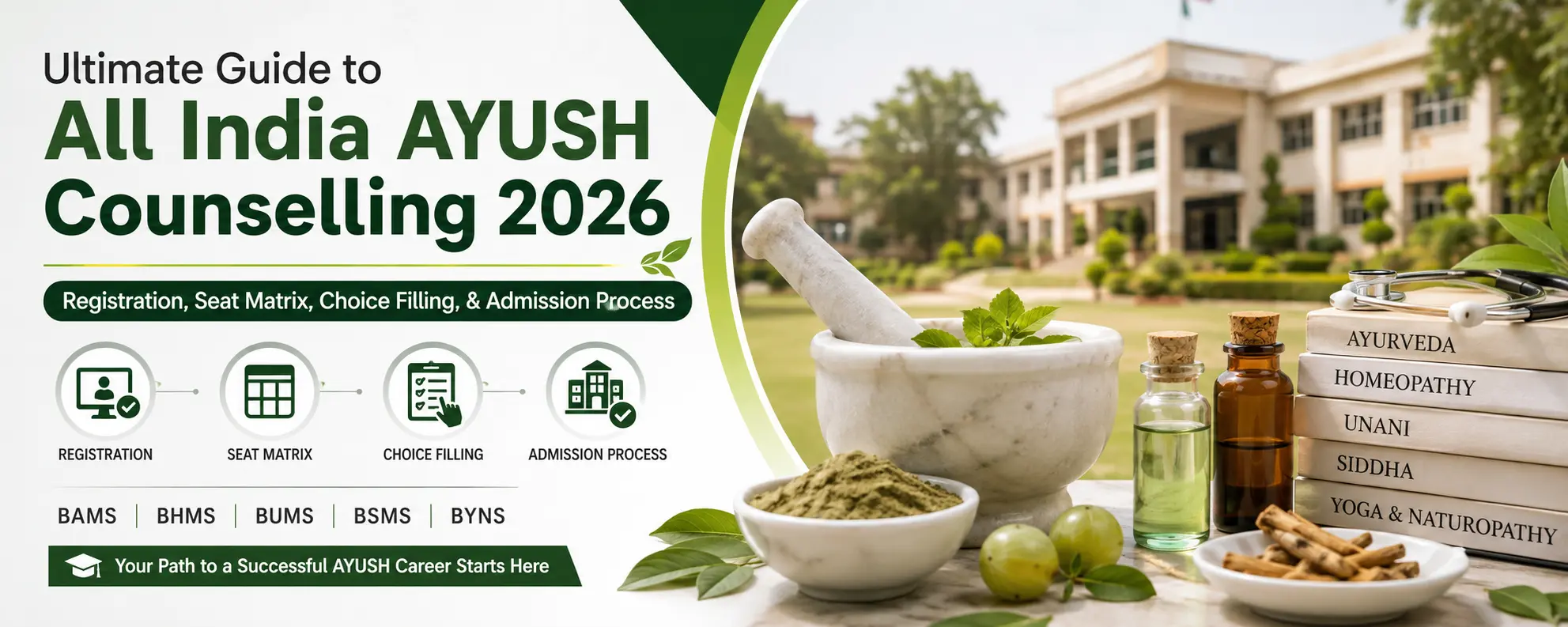




Ultimate Guide to All India AYUSH Counselling 2026: Registration, Seat Matrix, Choice Filling, & Admission Process
Securing a merit seat in MBBS or BDS is highly competitive, but a lower NEET UG 2026 score does not mean the end of your medical career. Every year, thousands of aspiring doctors pivot toward highly rewarding alternative medical streams by securing seats in BAMS, BHMS, BUMS, and BSMS courses.
However, navigating the central admission portal requires absolute precision. A minor oversight—such as missing the registration deadline, misinterpreting choice-locking algorithms, or submitting incorrect category documents—can cost you a seat at a premier government college. This comprehensive roadmap eliminates the confusion, offering a step-by-step breakdown of how seats are allotted across India’s top medical institutes.
Throughout this article, you will learn:
- What All India AYUSH Counselling 2026 is and who conducts it.
- Which colleges and seat categories are included.
- Eligibility criteria and NEET qualification requirements.
- Expected counselling schedule and important dates.
- Complete registration and choice-filling process.
- Seat matrix and reservation rules.
- Registration fees, security deposit, and refund policy.
- Documents required for counselling and reporting.
- Round-wise counselling process and seat upgradation rules.
- Common mistakes that students should avoid.
- Practical counselling strategies to maximise admission opportunities.
- Frequently asked questions asked by NEET aspirants across India.
Every section is designed to answer real questions that students commonly search for before participating in AYUSH counselling. The information is presented in a simple, structured, and easy-to-understand format so you can confidently complete each stage of the admission process.
Why Choose Krishna Education Consultancy?
- Top medical colleges in India & abroad — we guide you step-by-step
- From admission to visa — full support, no confusion
- Only National Medical Commission (NMC)-approved universities
- Advice based on your NEET score, budget & goals
What is All India AYUSH Counselling 2026?
All India AYUSH Counselling 2026 is the centralized online single-window system designed to allocate undergraduate seats in traditional medical systems based purely on your NEET rank. This entire web framework is managed and executed by the AYUSH Admissions Central Counselling Committee (AACCC).
Through this central application portal, you can claim institutional quotas across three primary categories:
- 15% All India Quota (AIQ): Government and Government-aided AYUSH seats spread across all Indian states.
- 100% Institutional Quota: Seats reserved at Central Universities (e.g., Banaras Hindu University) and apex National Institutes.
- 100% Open Seats: Management and NRI quota allocations across verified Deemed Universities.
What is AACCC?
The Ayush Admissions Central Counselling Committee (AACCC) operates directly under the Ministry of AYUSH, Government of India. This apex body executes single-window, merit-based online seat allocations for undergraduate medical courses utilizing your NEET UG 2026 score variables.
While state-level boards restrict entries based on regional domicile rules, this national framework permits eligible candidates from any Indian state to compete transparently across defined central pool quotas.
Which AYUSH Courses Are Covered Under AACCC Counselling?
Admissions via this national route apply exclusively to undergraduate medical degrees recognized by the National Commission for Indian System of Medicine (NCISM) and the National Commission for Homoeopathy (NCH):
The courses include:
- BAMS (Bachelor of Ayurvedic Medicine and Surgery)
- BHMS (Bachelor of Homoeopathic Medicine and Surgery)
- BUMS (Bachelor of Unani Medicine and Surgery)
- BSMS (Bachelor of Siddha Medicine and Surgery)
- B.Pharm (Ay): Bachelor of Pharmacy in Ayurveda (specifically at ITRA, Jamnagar)
Core Seat Categories Managed Under Central Allotments
A common misconception among NEET aspirants is that the central portal regulates all medical seats across India. In reality, the committee only processes allocations for these four distinctive institutional frameworks:
1. 15% All India Quota (AIQ) Government Seats
This quota opens up 15% of the total intake capacity of every state-run Government and Government-aided AYUSH college to out-of-state students.
Domicile restrictions do not apply here; seats are assigned purely on cross-India competitive merit rank
2. 100% Seats in Central Universities
All undergraduate AYUSH seats available in participating Central Universities are filled through AACCC counselling.
These universities are preferred by many students because they generally offer:
- Quality medical education
- Experienced faculty
- Affordable fee structure
- Well-equipped teaching hospitals
- Better academic exposure
3. 100% Seats in National Institutes
Apex research institutions utilize this platform to fill their entire intake. This includes prestigious hubs like the National Institute of Ayurveda (NIA), Jaipur, and the National Institute of Homoeopathy (NIH), Kolkata.
Competition here is fierce due to advanced clinical research opportunities.
4. 100% Seats in Participating Deemed Universities
Students can also apply for undergraduate AYUSH programmes offered by participating Deemed Universities through AACCC counselling.
These institutions generally provide:
- Wider seat availability
- Modern campus facilities
- Digital classrooms
- Advanced laboratories
- Better accommodation facilities
Although the tuition fees may be comparatively higher than government colleges, deemed universities provide additional admission opportunities, particularly for students with moderate NEET ranks.
Which Seats Are Not Managed by AACCC?
To avoid administrative mistakes, remember that the central committee does not process:
- 85% State Quota seats in Government AYUSH colleges.
- State-specific AYUSH admissions managed by individual counselling authorities.
- Most private AYUSH colleges that participate only in state counselling.
These admissions are conducted separately by the respective state counselling authorities according to their own schedules and admission rules.
AACCC Counselling vs State AYUSH Counselling
Many students think they must choose between AACCC counselling and state counselling. In reality, eligible candidates can usually participate in both, provided they meet the applicable eligibility requirements.
| Admission Feature | AACCC Counselling | State Ayush Counselling |
|---|---|---|
| Conducting Authority | Ministry of Ayush through AACCC | Respective State Counselling Authority |
| Admission Level | National (All India Level) | Regional (State Level) |
| Government Seats | 15% All India Quota (AIQ) | 85% State Quota Pool |
| Central Universities | Yes (100% Seats Included) | No |
| National Universities | Yes (100% Seats Included) | No |
| Deemed Universities | Yes (100% Seats Included) | Generally No |
| State Government Colleges | Limited (Only the 15% AIQ seats) | Yes (Manage the Remaining 85% seats) |
Participating in both counselling processes can significantly increase your chances of securing admission to a preferred AYUSH college.
Confused About Which Medical Course to Choose?
Choosing the right path after 12th PCB can be overwhelming, but expert guidance can help you make a confident decision.
Expected AYUSH Counselling Timeline 2026
| Admission Stage | Expected Operational Window | Core Action Required |
|---|---|---|
| Official Seat Matrix Release | August 2026 | Analyze seat distribution across specific categories |
| Round 1 Application Window | August 2026 | Complete Registration and process secure portal fees |
| Choice Locking Pahase | August 2026 | Save and Lock preferred institutional choices |
| Round 1 Seat Allotment | August/September 2026 | Check results via student dashboard login |
| Physical Reporting Timeline | September 2026 | Submit physical documents at the alloted medical college |
| Round 2 Processing Window | September 2026 | Fresh choice filling and institutionalupgradation entry |
| Round 3 Seat Allocations | October 2026 | Mandatory entry for remaining clear vacancies |
| Online Stray Vacancy Round | October/November 2026 | Final Allotment phase for unfilled seat pools. |

Still Confused About Your Career?
It’s better to take guidance now than regret your decision later.
Strategic Overview of Allotment Phases
The Ayush Admissions Central Counselling Committee (AACCC) operates four specific online windows to systematically distribute vacant medical seats without manual intervention: [2, 4]
- Round 1 (Free Exit Enabled): Allows candidates to opt out without losing their security deposit if they dislike the allotted college.
- Round 2 (Seat Upgradation): Designed for registered students looking to slide up to a higher preferred choice based on merit rank.
- Round 3 (Strict Allocation): Fresh registrations are allowed, but choices must be evaluated carefully as free exits are generally restricted here.
- Stray Vacancy Round: An automated process utilizing remaining unallocated seats with no fresh choice filling permitted.
Critical Pitfalls: Why Missing Deadlines is Costly
In central seat allocation systems, deadlines are absolute. Missing a single timeline window triggers immediate administrative penalties:
- Registration Exclusion: Failing to register during the initial window prevents you from entering Round 1 seat processing.
- Systemic Choice Deletion: If you fail to hit the ‘Choice Lock’ button, the system may automatically freeze your last saved preferences or leave your choices completely blank.
- Financial Deposit Forfeiture: Securing a seat in later rounds and failing to report can lead to the complete forfeiture of your refundable security deposit.
Expert Intelligence: How to Avoid Admission Errors
- Verify Domicile Profiles: Ensure your reservation certificates match national formats (especially for OBC-NCL and EWS quotas) before the portal opens.
- Analyze Historic Closing Ranks: Use previous cutoff matrices as a baseline reference, but do not rely on them entirely due to shifting competition densities every year.
- Track Portal Communications: Check the Official AACCC Announcement Board daily to avoid relying on unverified social media information.
Eligibility Criteria for All India AYUSH Counselling 2026
Before registering for All India AYUSH Counselling 2026, every candidate must ensure that they meet the prescribed eligibility requirements. Simply appearing for NEET UG 2026 does not automatically make a student eligible for counselling.
Admission is granted only to candidates who satisfy the academic, age, qualifying examination, and category-specific conditions laid down in the counselling guidelines.
Understanding these requirements before registration helps you avoid application rejection, document verification issues, and unnecessary delays during counselling.
Who Can Participate in All India AYUSH Counselling 2026?
You can participate in AACCC UG Counselling 2026 if you:
- Qualified NEET UG 2026.
- Fulfil the prescribed age criteria.
- Have passed Class 12 (or equivalent) from a recognised board.
- Studied the required science subjects.
- Meet the minimum qualifying criteria applicable to your category.
- Satisfy any additional eligibility conditions mentioned in the official Information Bulletin.
Meeting all these conditions is essential before completing your online registration.
Educational Qualification
Candidates must have completed Class 12 (10+2) or an equivalent examination from a recognised board.
The qualifying examination should include the following compulsory subjects:
- Physics
- Chemistry
- Biology/Biotechnology (as applicable)
- English
These subjects form the academic foundation for admission to undergraduate AYUSH programmes. Candidates who do not fulfil this requirement are not eligible for counselling.
Senior Secondary (10+2) Qualifying Marks
| Condidate Category Profile | Mandatory Minimum PCB Aggregate |
|---|---|
| General/Unreserved/EWS | Minimum 50% Marks |
| OBS/SC/ST | Minimum 40% Marks |
| Persons with Disabilities (PwD) General Pool | Minimum 45% Marks |
Age Matrix Parameters
- Minimum Threshold: Candidates must be at least 17 years of age on or before December 31, 2026.
- Maximum Ceiling: There is no upper age limit restriction for the 2026 academic calendar. Candidates of any age can register, provided they clear the baseline NEET cutoff.
Category-wise NEET Qualifying Criteria
To become eligible for AYUSH counselling, candidates must obtain the minimum qualifying percentile prescribed for their category in NEET UG.
Generally, the qualifying criteria are:
| Category | Required NEET Qualifying Percentile |
|---|---|
| General/Unreserved/EWS | Minimum 50th Percentile |
| OBS/SC/ST | Minimum 40th Percentile |
| Persons with Disabilities (PwD) General Pool | Minimum 45th Percentile |
The corresponding qualifying marks vary each year depending on the overall performance of candidates in NEET UG. Therefore, students should always refer to the officially declared NEET qualifying criteria for the relevant admission year.
Eligibility for Reserved Categories
Candidates claiming reservation benefits must possess valid certificates issued in the prescribed format.
Depending on the applicable reservation category, candidates may need to submit:
- Scheduled Caste (SC) Certificate
- Scheduled Tribe (ST) Certificate
- Other Backward Class (OBC-NCL) Certificate
- Economically Weaker Section (EWS) Certificate
- Persons with Disabilities (PwD) Certificate
Certificates must comply with the requirements mentioned in the official counselling guidelines. Invalid, expired, or incorrectly issued certificates may lead to the rejection of the reservation claim during document verification.
Who Is Not Eligible for AACCC Allotments?
A candidate may become ineligible if they:
- Have not qualified for NEET UG 2026.
- Failed to clear the Class 12 PCB aggregate marks rule.
- Turn 17 years old after December 31, 2026.
- Typed incorrect or mismatched personal data during registration.
- Brought expired or wrongly formatted category certificates to verification.
- Missed the mandatory physical reporting deadline at your allotted college.
- Already joined and locked a seat through State Quota counselling.
- Walked away from a Round 3 seat, which blocks you from the Stray Vacancy round.
- Broke any official security deposit or exit rules set by the AACCC Portal.
Checking your eligibility before registration can save significant time and help you avoid complications later in the admission process.
Understanding the AACCC AYUSH Seat Matrix
Your NEET UG 2026 score determines your eligibility, but the live institutional seat matrix dictates your actual allotment probability. Released by the Ayush Admissions Central Counselling Committee (AACCC) before each round, this online document tracks live college-wise, course-wise, and category-wise seat distributions across India.
Because seat availability shifts dynamically after every round as candidates accept, reject, or upgrade their choices, checking the latest matrix iteration before modifying your preferences is critical.
What is Included in the Central Allocation Matrix?
- 15% All India Quota (AIQ): Open merit seats across all state-run government and government-aided AYUSH colleges.
- 100% Central Universities: Total seat intake for premium hubs like Banaras Hindu University (BHU).
- 100% National Institutes: Complete seat inventories for apex research institutions like NIA Jaipur or NIH Kolkata.
- 100% Deemed Universities: All management and NRI quota options open to non-domicile candidates.
Reservation Rules Under AACCC AYUSH Counselling
Reservation plays an important role in the counselling process. Seats are allotted according to the reservation policy applicable to the respective institution and seat category.
For the 15% All India Quota and institutions governed by Central Government norms, reservation generally follows the prescribed central policy. Candidates claiming reservation benefits must produce valid supporting documents during document verification. ([NCH][3])
Central Reservation Categories
| Candidate Category Profile | Central Reservation Percentage |
|---|---|
| General/Unreserved (UR) | Remainder of open merit seats |
| Other Backward Classes (OBC-NCL) | 27% Reservation |
| Scheduled Caste (SC) | 15% Reservation |
| Economically Weaker Sections (EWS) | 10% Reservation |
| Scheduled Tribe (ST) | 7.5% Reservation |
| Persons with Disabilities (PwD) | 5% Horizontal Reservation Across all pools |
Reservation in Deemed Universities
Deemed Universities do not observe the standard central reservation percentages listed above. Instead, their seat matrices are split cleanly into General Management Seats (open to all Indian ranks on pure merit) and 15% NRI Quota Seats.
Strategic Move: Seat Conversion Mechanics
One of the most overlooked aspects of choice filling is the automated seat-conversion rule that is executed during later rounds. If qualified candidates under specific quotas are unavailable, the portal converts vacant seats to widen the selection pool:
- PwD Seats: Unfilled horizontal PwD seats revert directly to their parent vertical categories (e.g., SC-PwD shifts to open SC).
- ST to SC: Vacant Scheduled Tribe seats convert directly into Scheduled Caste openings if no eligible ST candidates remain on the merit list.
- SC/OBC/EWS to UR: If seats remain unallocated in the final stages, they clear out into the open General (Unreserved) pool.
Data-Driven Choice Filling Strategy (Expert Tip)
Do not judge your chances of admission solely by previous years’ closing ranks. Shifting competitive density, new college approvals, and changing seat counts mean historical cut-offs should only be used as a loose baseline—never a guarantee.
Instead, group your choice-filling list into three logical human brackets:
- Ambitious Choices: Dream colleges slightly above your actual rank profile.
- Realistic Choices: Colleges that historically match your exact score range.
- Safe Backups: Institutes with higher seat capacities to prevent a total admission shutout.
Step-by-Step AACCC Registration Process 2026
Mandatory Credentials Checklist
Gather these verified personal and academic records before opening the active registration dashboard:- NEET UG 2026 Credentials: Your official Roll Number, Application Number, and Rank Card.
- Contact Information: Your active mobile number and personal email ID registered with the NTA.
- Identity Records: Clear digital copies of your Aadhaar Card, Passport, or valid Photo ID.
- Academic Certificates: Class 10 and Class 12 mark sheets for exact PCB aggregate entry.
- Category Quota Files: Central-format OBC-NCL, EWS, SC, ST, or authorized PwD screening certificates issued on or after April 1, 2026.
Step 1: Initial Account Activation & Security
Visit the single-window admission portal and locate the “New Candidate Registration” option. Input your baseline NEET credentials exactly as they appear on your NTA scorecard. The system will authenticate your profile via a secure mobile and email OTP gateway. Once verified, create a strong alphanumeric password to lock your student login dashboard. Expert Tip: Never share your password or security question answers with coaching agents or third-party consultants. This protects your profile from unauthorized preference changes later.| Personal Identity | Academic Matrics | Communication Hub | |
|---|---|---|---|
| Condidate Legal Name | Class 10 Board Details | Permanent Residential Address | |
| Father’s and Mother’s Name | Class 12 Aggregate Marks | Local Correspondence Address | |
| Gender And Nationality | Physics/Biology/Chemistry % | Active Statea and District PIN |
Step 2: Comprehensive Profile & Academic Entry
Log in to your activated account to access the official admission application form. You must carefully fill out four core informational blocks:Step 3: Quota Selection & Reservation Locking
If you are seeking vertical or horizontal reservation benefits, choose your exact category (OBC-NCL, EWS, SC, ST, or PwD) during this step. Your selection here must match your central government certificates. Selecting a reserved category without a matching, updated certificate will result in your application being shifted to the open Unreserved (UR) category, which will instantly alter your merit cut-offs.Step 4: Processing Fee Gateway & Security Deposits
To unlock the choice-filling matrix, you must clear the mandatory, non-refundable registration processing fee alongside the refundable security deposit. The payment portal securely accepts entries via Credit Card, Debit Card, Net Banking, or verified UPI modes.| Selected Institute Choice Path | Non-Refundable Fees Amount | Refundable Security Deposit | ||
|---|---|---|---|---|
| AIQ Government/Central Pool (General/OBS) | ₹1,000 | ₹10,000 | ||
| AIQ Government/Central Pool (SC/ST/PwD) | ₹500 | ₹10,000 | ||
| Deemed Universities (All Categories) | ₹5,000 | ₹50,000 |
Step 5: Dashboard Status Verification
After making your payment, wait for the screen to refresh. Do not close your browser early. Log back into your student profile to confirm your transaction receipt status. Your active status should explicitly read “Payment Successful” and “Registration Complete.” Keep a digital screenshot of this dashboard confirmation for your personal records.Step 6: Strategic Choice Filling Matrix
Once verified, the portal opens your choice-filling window. Here, you can select and arrange your ideal combinations of courses (BAMS, BHMS, BUMS, BSMS) and medical colleges. There is no upper limit on the number of choices you can select. To minimize your chances of an admission shutout, structure your preference list into three distinct brackets:- Ambitious Selections: Top-tier national institutes slightly above your predicted rank.
- Realistic Selections: Reputed government colleges matching historical cutoff trends.
- Safe Backups: High-capacity colleges to secure an initial seat allocation.
Step 7: Manual Choice Locking Protocols
Review your final college preference list carefully. Once you are satisfied with the vertical order, click “Lock Choices” and verify the action with a mobile OTP. If you miss the deadline, the system servers will auto-freeze your last saved sequence. However, locking your choices manually remains the safest way to ensure your preferences are securely processed by the seat allotment algorithms.Step 8: Document Archiving
Once the portal confirms your choice submission, download and save the registration acknowledgment packet. Keep four physical printouts of the following items for your physical reporting kit:- Complete Registration Confirmation Page.
- Official Online Fee Transaction Receipt.
- Locked Choice Preference Summary Sheet.
Choice Filling Strategy for AYUSH Counselling 2026
Securing a competitive NEET UG 2026 score represents only half the battle. Your eventual medical seat allocation depends entirely on your online choice-filling order. Every year, high-scoring candidates miss out on elite national institutes due to poorly structured preference lists, while smart aspirants with modest ranks secure excellent government seats by running a calculated preference matrix.
The central allocation system operates via automated top-down algorithms. The software scans your first preference; if that college has no vacancy matching your rank, it instantly drops to your second choice. It continues down your list until it finds an available seat.
Never rank colleges based on where you think you will get in. Always arrange them based entirely on where you want to study. If you place a lower-tier college at the top of your list as a “safe bet,” the software will allocate that seat instantly, permanently blocking you from better choices listed further down.
Essential Metrics to Evaluate Before Shortlisting Colleges
Do not wait for the active counselling portal to open to research your selections. Compile an offline preference sheet beforehand by cross-checking these core operational variables:
- Clinical Patient Footfall: Prioritize older government institutions with busy teaching hospitals to ensure deep clinical exposure during your clinical rotations.
- Language Barrier Variables: Ensure you are completely comfortable with the local language of the state, as you must interact with local patients during your hospital duties.
- Compulsory Service Bonds: Research state-specific rural service bond periods and financial penalty rules before locking choices to avoid long-term legal deadlocks.
The 3-Tier Choice Optimization Matrix
To eliminate the risk of an admission shutout, group your choice-filling list into three logical human brackets:
- Tier 1: Ambitious Selections (Dream Colleges): Place premium apex hubs like Banaras Hindu University (BHU) or the National Institute of Ayurveda (NIA), Jaipur at the absolute top of your list (15-20% of entries).
- Tier 2: Realistic Selections (Target Institutions): Devote 50-60% of your list to reputable state government colleges where your NEET rank comfortably aligns with previous closing matrices.
- Tier 3: Safe Selections (Backup Options): Conclude your preference list with stable, high-capacity backup choices where your score safely clears historic cutoffs. This acts as an insurance policy against a total seat shutout.
Government vs Deemed University Allocation Split
| Preference Placement | Quota Tracking Track | Tactical Admission Profile | ||
|---|---|---|---|---|
| Top of the List | 15% AIQ Government Pools | Premium, heavily subsidized merit seats | ||
| Mid Section Pool | Central Universities and National Hubs | Apex research-driven medical campuses | ||
| Lower Section Base | Participating Deemed Management | High Budget backup alternatives |
Critical Choice-Filling Pitfalls to Avoid
- Relying Blindly on Last Year’s Closing Ranks: Historic cut-offs are helpful guidelines, but shifting competition densities, fresh college approvals, and revised reservation rules mean they are never a guarantee.
- Selecting “Dead Ends”: Never add a college where you are completely unwilling to study. Securing a seat in later rounds and executing a non-reporting exit can trigger harsh financial penalties or block you from the Stray Vacancy round.
- Limiting Your Choice Counts: Entering a tiny list of 3–5 highly competitive colleges is a major risk. If your score misses those specific cut-offs, the system skips your profile entirely, leaving you unallotted for that round.
Registration Fee, Security Deposit & Refund Rules for AACCC AYUSH Counselling 2026
Completing the registration process is not enough to participate in All India AYUSH Counselling 2026. Candidates must also pay the prescribed registration fee and, where applicable, a refundable security deposit. Your registration is considered complete only after the payment is successfully processed within the notified timeline.
Many students become confused about the difference between the registration fee and the security deposit. These are two separate charges with different purposes. Understanding how they work can help you avoid payment-related mistakes and prevent unnecessary financial loss during counselling.
Important: The fee structure and security deposit may be revised by the counselling authority. Candidates should always verify the latest notification before making any payment.
Registration Fee vs Security Deposit: What's the Difference?
Although both payments are made during counselling registration, they serve different purposes.
Registration Fee: A non-refundable amount charged for processing your counselling application.
Security Deposit: A refundable amount collected to ensure that candidates participate responsibly in the counselling process and comply with the applicable admission rules.
Simply put, the registration fee covers the counselling process, while the security deposit acts as a commitment amount that may be refunded if the prescribed conditions are fulfilled.
Registration Fee for AACCC AYUSH Counselling 2026
The registration fee generally varies depending on the type of institution and the candidate’s category.
For Government Colleges, Government-Aided Colleges, Central Universities, and National Institutes, the counselling authority usually prescribes a lower registration fee compared to Deemed Universities.
For Deemed Universities, the registration fee is generally higher because these institutions follow a different counselling fee structure.
Candidates should check the latest Information Bulletin before registration to confirm the applicable amount.
Security Deposit
Along with the registration fee, candidates are required to pay a security deposit based on the type of counselling they are participating in.
The security deposit is collected to discourage candidates from blocking seats unnecessarily and then leaving the counselling process without following the applicable rules.
The amount may vary depending on whether you are applying for:
- Government institutions
- Central Universities
- National Institutes
- Deemed Universities
Always select your counselling category carefully before making the payment because the applicable security deposit depends on the options you choose during registration.
How to Pay the Counselling Fee
AACCC provides an online payment system for counselling registration.
Candidates can usually pay using:
- UPI
- Debit Card
- Credit Card
- Net Banking
- Other online payment methods available on the official portal
After completing the transaction, wait until the payment status is confirmed on the counselling dashboard. Do not refresh the page or close the browser while the transaction is being processed.
When Will the Security Deposit Be Refunded?
The security deposit is not refunded immediately after counselling. The refund process is initiated according to the counselling rules after the completion of the admission process.
If a candidate follows the prescribed counselling rules and remains eligible for a refund, the amount is generally returned through the same banking channel used during payment or through the process notified by the counselling authority.
The exact refund timeline may vary each year depending on administrative procedures.
In Which Situations Can You Lose the Security Deposit?
This is one of the most important areas that every candidate should understand before participating in counselling.
The security deposit may be forfeited if a candidate violates the applicable counselling rules.
Examples may include:
Not reporting to the allotted institute when required under the applicable round rules.
Leaving an allotted seat in situations where forfeiture provisions apply.
Violating the counselling conditions mentioned in the official Information Bulletin.
The exact forfeiture rules may differ depending on the counselling round and the category of the allotted seat. Therefore, candidates should read the latest counselling guidelines carefully before making any admission-related decision.
Tips to Avoid Payment-Related Problems
Many payment issues can be avoided by following a few simple precautions.
- Use a stable internet connection while making the payment.
- Avoid making transactions during the last few hours before the deadline.
- Do not make multiple payments if the payment status is pending.
- Save the transaction receipt immediately after successful payment.
- Verify your payment status from the counselling dashboard before logging out.
- Contact the official counselling helpdesk if the amount is deducted, but the payment is not updated.
Taking these precautions can help you avoid unnecessary delays during the registration process.
Round-wise AYUSH Counselling Process 2026: Complete Admission Flow Explained
After completing your registration, choice filling, and document preparation, the next stage is the seat allotment process. All India AYUSH Counselling 2026 is conducted in multiple rounds to ensure that the maximum number of seats across participating institutions are filled fairly and transparently.
Each counselling round follows a defined process, and candidates are given different options depending on whether they receive a seat, wish to upgrade, or participate in subsequent rounds. Understanding these rules before counselling begins will help you make informed decisions and avoid losing admission opportunities due to confusion or missed deadlines.
Important: The exact counselling rules for each round are published in the official AACCC Information Bulletin. Candidates should always refer to the latest notification before making any admission-related decision.
How Does the Seat Allotment Process Work?
Seat allotment is carried out through a computerised merit-based system.
The system considers multiple factors simultaneously, including:
- NEET UG 2026 All India Rank
- Reservation Category
- Eligibility
- Seat Availability
- Order of Choices Filled
- Counselling Round Rules
Once the allotment process is completed, candidates can download their Seat Allotment Letter from the official counselling portal.
Round 1 Counselling
Round 1 is the first opportunity for eligible candidates to secure admission through AACCC counselling.
What Happens in Round 1?
Candidates:
- Complete registration.
- Pay the counselling fee.
- Fill and lock their college preferences.
- Participate in the first seat allotment.
After the result is declared, candidates can check whether a seat has been allotted.
If allotted a seat, they must follow the instructions mentioned in the allotment letter and complete the reporting process within the prescribed timeline.
Who Should Participate in Round 1?
Round 1 is suitable for:
- First-time counselling participants.
- Students aiming for Government AYUSH Colleges.
- Candidates targeting Central Universities.
- Applicants interested in National Institutes.
- Students considering Deemed Universities.
Even if you are uncertain about your admission chances, participating in Round 1 is generally advisable because it gives you the maximum number of opportunities in subsequent rounds, subject to the applicable counselling rules.
Round 2 Counselling
After Round 1 is completed, AACCC conducts Round 2.
Seats that remain vacant due to non-reporting, resignations (where permitted), or newly available seats are offered again during this round.
Candidates who remain eligible under the counselling guidelines may participate according to the applicable rules.
Who Can Participate in Round 2 ?
Depending on the official counselling guidelines, Round 2 may include:
- Candidates who did not receive any seat in Round 1.
- Newly eligible candidates, if permitted.
- Candidates eligible for upgradation according to the counselling rules.
Always verify the latest eligibility conditions before Round 2 registration.
What is Seat Upgradation?
Seat upgradation allows eligible candidates to receive a more preferred college or course in a later counselling round.
For example:
Suppose your preference order is:
- Government BAMS College A
- Government BAMS College B
- BHMS College C
If you receive College B in Round 1 but become eligible for College A in Round 2 based on seat availability and your merit, your seat may be upgraded according to the counselling rules.
This is why arranging your preferences correctly during choice filling is extremely important.
Round 3 (Formerly Mop-Up Round)
The Mop-Up Round is generally conducted to fill seats that remain vacant after the earlier counselling rounds.
These vacancies may arise because of:
- Non-reporting
- Seat cancellation
- Withdrawal as permitted under the rules
- Newly added seats
- Other administrative reasons
Candidates who remain eligible under the applicable counselling guidelines may participate in this round.
Why is the Mop-Up Round Important?
Many students focus only on the first two rounds.
However, the Mop-Up Round often provides additional admission opportunities because:
- Vacant seats become available.
- Candidate preferences change.
- Some students opt for other institutions.
- Seat movement continues across participating colleges.
Candidates should carefully review the updated seat matrix before filling fresh preferences for this round.
Stray Vacancy Round
The Stray Vacancy Round is the final phase of AACCC counselling, conducted to fill the remaining vacant seats across participating institutions.
Crucial Stray Vacancy Rules
- No Fresh Registration: Only registered candidates who have not been allotted any seat in previous rounds are eligible.
- No Fresh Choice Filling: Allotments are strictly processed based on the preferences filled during Round 3.
Severe Penalty Warning
- One-Year Ban: If a seat is allotted to you in the Stray Vacancy Round and you do not join the college, your security deposit will be forfeited.
- Future Debarment: You will be legally debarred (banned) from participating in NEET AYUSH counselling for the next 1 academic year.
What Happens After Seat Allotment?
Once a seat is allotted, candidates should carefully read the allotment letter.
The next steps usually include:
- Download the Seat Allotment Letter.
- Verify the reporting schedule.
- Carry all required original documents.
- Report to the allotted institute.
- Complete document verification.
- Pay the institute fee (if applicable).
- Confirm admission according to the prescribed procedure.
Failure to complete these formalities within the specified timeline may affect your admission.
What If You Do Not Receive a Seat?
Not receiving a seat in the first counselling round does not necessarily mean the end of your admission journey.
Many candidates secure admission in later rounds because:
- Additional seats become available.
- Other candidates do not report.
- New institutions participate.
- Seat conversions take place according to counselling rules.
- Closing ranks change across rounds.
Remain patient, monitor official notifications, and participate in subsequent rounds if you remain eligible.
Common Mistakes Students Make During All India AYUSH Counselling 2026 (And How to Avoid Them)
Every year, thousands of NEET-qualified students participate in All India AYUSH Counselling with the hope of securing admission to their preferred BAMS, BHMS, BUMS, or BSMS college. However, not every candidate loses a seat because of a low NEET rank. Many students miss admission opportunities due to avoidable mistakes made during registration, choice filling, document verification, or reporting.
Most of these mistakes are preventable if you understand the counselling process and prepare in advance. This section highlights the most common errors made by students and explains how to avoid them so that you can participate in the counselling process with confidence.
1. Registering at the Last Minute
One of the biggest mistakes students make is waiting until the final day to register.
During the last few hours of registration, the counselling portal may experience:
- Heavy traffic
- Slow loading
- Payment delays
- OTP issues
- Temporary technical interruptions
These problems can prevent successful registration before the deadline.
How to Avoid It
- Register as soon as the registration window opens.
- Complete the payment well before the last date.
- Verify your registration status after payment.
Early registration gives you enough time to resolve any technical issues without unnecessary stress.
2. Entering Incorrect Personal or Academic Details
Some candidates enter incorrect information while filling the application form.
Common errors include:
- Incorrect spelling of the candidate’s name
- Wrong date of birth
- Incorrect NEET Roll Number
- Incorrect category selection
- Wrong contact details
Even small mistakes can create problems during document verification.
How to Avoid It
Before submitting your application:
- Match every detail with your NEET scorecard.
- Verify your Class 10 and Class 12 records.
- Review the complete application before final submission.
3. Not Reading the Official Information Bulletin
Many students depend entirely on YouTube videos, Telegram channels, or social media updates.
While these sources may provide useful guidance, they should never replace the official AACCC Information Bulletin.
The bulletin contains important information about:
- Eligibility
- Counselling rules
- Seat allotment
- Reporting
- Refund policy
- Reservation
- Exit rules
Ignoring these guidelines can lead to incorrect decisions during counselling.
How to Avoid It
Download the latest Information Bulletin and read it carefully before registration.
4. Filling Too Few College Choices
Some students believe that selecting only five or ten colleges improves their chances of admission.
This is a misconception.
If those colleges are highly competitive and no seat is available according to your rank, you may remain unallotted despite being eligible for other institutions.
How to Avoid It
Prepare a balanced preference list that includes:
- Dream Colleges
- Realistic Colleges
- Safe Colleges
Add every college where you are genuinely willing to study.
5. Arranging Colleges in the Wrong Preference Order
The counselling system checks your choices from top to bottom.
If your preference order does not reflect your actual priorities, you may receive a seat in a less preferred college while missing a better option that you would have chosen differently.
How to Avoid It
Arrange colleges according to your genuine preference—not based only on expected cut-offs or advice from others.
Review the entire list before locking your choices.
6. Ignoring Deemed Universities
Many candidates focus only on Government colleges and do not include reputed Deemed Universities in their preference list.
As a result, they reduce their admission opportunities, especially if their NEET rank is not competitive for Government seats.
How to Avoid It
If your budget allows, include well-recognised Deemed Universities after your preferred Government institutions.
This approach increases your chances of receiving a seat without affecting your higher preferences.
7. Depending Only on Previous Year’s Closing Ranks
Previous years’ opening and closing ranks are useful for understanding admission trends, but they are not guaranteed cut-offs.
Closing ranks may change due to:
- Seat additions
- New colleges
- Candidate preferences
- Reservation updates
- Number of applicants
How to Avoid It
Use previous years’ data as a planning tool, not as the only basis for your counselling strategy.
8. Not Checking Updated Seat Matrices
Some students prepare their college list only once and never review the revised seat matrix released before later counselling rounds.
This may cause them to miss newly added seats or additional admission opportunities.
How to Avoid It
Download the latest seat matrix before every counselling round and update your strategy if required.
9. Missing the Reporting Deadline
Receiving a seat allotment does not complete the admission process.
Candidates must report to the allotted institute within the prescribed reporting period.
Missing the reporting deadline can affect your admission according to the applicable counselling rules.
How to Avoid It
Download the allotment letter immediately.
Confirm the reporting dates.
Plan your travel.
Reach the institute before the reporting deadline.
10. Carrying Incomplete Documents
Some candidates forget to carry:
- Original certificates
- Category certificates
- Identity proof
- Passport-size photographs
- Seat allotment letter
Incomplete documentation can delay or affect the admission process.
How to Avoid It
Prepare your document file several days before reporting.
Cross-check every required document using the official checklist.
11. Ignoring Official Notifications After Registration
Many students stop checking the counselling portal after completing registration.
However, important updates may still be released, including:
- Revised schedules
- Updated seat matrices
- Fresh notices
- Additional instructions
Missing these notifications can directly affect your participation.
How to Avoid It
Visit the official counselling portal regularly until the entire admission process is completed.
12. Believing Unverified Social Media Rumours
Counselling season is often filled with unofficial messages claiming:
- Cut-off predictions
- Seat confirmations
- Last-minute rule changes
- Fake admission updates
Relying on such information may lead to poor decisions.
How to Avoid It
Always verify every important update through the official AACCC website before taking any action.
Frequently Asked Questions (FAQs) About All India AYUSH Counselling 2026
-
1. What is All India AYUSH Counselling 2026?
All India AYUSH Counselling 2026 is the centralized online admission process conducted by the Ayush Admissions Central Counselling Committee (AACCC) for eligible NEET UG 2026 qualified candidates seeking admission to undergraduate AYUSH courses, including BAMS, BHMS, BUMS, and BSMS. The counselling covers 15% All India Quota Government seats, Central Universities, National Institutes, and participating Deemed Universities.
-
2. Is NEET UG 2026 compulsory for AYUSH admission?
Yes. NEET UG 2026 qualification is mandatory for admission to undergraduate AYUSH courses through AACCC counselling. Candidates who do not qualify NEET are not eligible to participate in the counselling process.
-
3. Who conducts All India AYUSH Counselling?
The counselling is conducted by the Ayush Admissions Central Counselling Committee (AACCC) under the Ministry of AYUSH, Government of India.
-
4. Which courses are included in AYUSH Counselling?
The undergraduate AYUSH courses include:
- BAMS (Bachelor of Ayurvedic Medicine and Surgery)
- BHMS (Bachelor of Homoeopathic Medicine and Surgery)
- BUMS (Bachelor of Unani Medicine and Surgery)
- BSMS (Bachelor of Siddha Medicine and Surgery)
-
5. Which seats are covered under AACCC Counselling?
AACCC conducts counselling for:
- 15% All India Quota (AIQ) Government AYUSH seats
- 100% seats in participating Central Universities
- 100% seats in National Institutes
- 100% seats in participating Deemed Universities
The remaining 85% State Quota seats are filled through the respective State AYUSH Counselling Authorities.
-
6. Can I participate in both AACCC and State AYUSH Counselling?
Yes. If you meet the eligibility requirements prescribed by the respective counselling authorities, you can generally participate in both AACCC Counselling and your State AYUSH Counselling, thereby increasing your admission opportunities.
-
7. How many counselling rounds are conducted?
AACCC generally conducts multiple counselling rounds:
- Round 1
- Round 2
- Round 3
- Stray Vacancy Round (if seats remain vacant)
The exact number of rounds depends on the official counselling schedule.
-
8. How is the seat allotment decided?
Seat allotment is based on several factors, including:
- NEET UG Rank
- Reservation Category
- Eligibility
- Seat Availability
- Choice Filling Order
- Counselling Rules applicable to that round
Merely qualifying NEET does not guarantee admission.
-
9. What documents are required during reporting?
Candidates are generally required to carry:
- NEET UG Admit Card
- NEET UG Scorecard
- AACCC Seat Allotment Letter
- Class 10 Certificate
- Class 12 Marksheet and Passing Certificate
- Valid Government Photo ID
- Passport-size Photographs
- Category Certificate (if applicable)
- PwD Certificate (if applicable)
- Other documents specified by the allotted institute
Always verify the latest document checklist issued by AACCC.
-
10. Is the counselling registration fee refundable?
No. The registration fee is generally non-refundable. However, the security deposit may be refundable if the candidate fulfils all the conditions mentioned in the official counselling guidelines.
-
11. How can I improve my chances of getting a good AYUSH college?
You can improve your admission chances by:
- Registering early
- Filling a balanced list of college choices
- Including Government and Deemed Universities where appropriate
- Reviewing the latest seat matrix before every round
- Arranging colleges according to your genuine preference
- Keeping all documents ready before reporting
- Following every official counselling notification carefully
-
12. Where can I check the official AYUSH Counselling updates?
Candidates should regularly visit the official AACCC counselling website for the latest notifications, counselling schedule, seat matrix, registration dates, and admission guidelines. Avoid relying solely on unofficial social media updates or rumours.
Need Help with NEET UG Counselling 2026?
Get expert Guidance for Registration, Choice Filling,
College Selection and Document Varification
Conclusion
Choosing the right AYUSH college involves much more than simply qualifying for NEET UG 2026. A successful admission relies heavily on understanding the exact round-wise counselling process, making informed college choices, completing every reporting step on time, and strictly following the official guidelines.
In this comprehensive guide, we covered every critical stage of All India AYUSH Counselling 2026—from initial registration to the strict penalty rules of Round 3 and the final Stray Vacancy Round. Highlighting these common mistakes ensures you can navigate the process securely without risking your security deposit or losing your hard-earned seat.
Remember, your NEET rank is only one part of the journey. A well-planned strategy, a balanced preference list, and swift actions before deadlines can significantly upgrade your chances of securing admission into your dream BAMS, BHMS, BUMS, or BSMS institution.
Because schedules and seat matrices change dynamically, always rely exclusively on official announcements. Check the official AACCC portal before making any permanent moves, stay organized, and approach your career in the AYUSH healthcare system with total confidence.
Confused about your medical college admission?
A great NEET score is a huge win. Do not let choice-filling mistakes waste your hard work.
Our Most Recent Blogs