


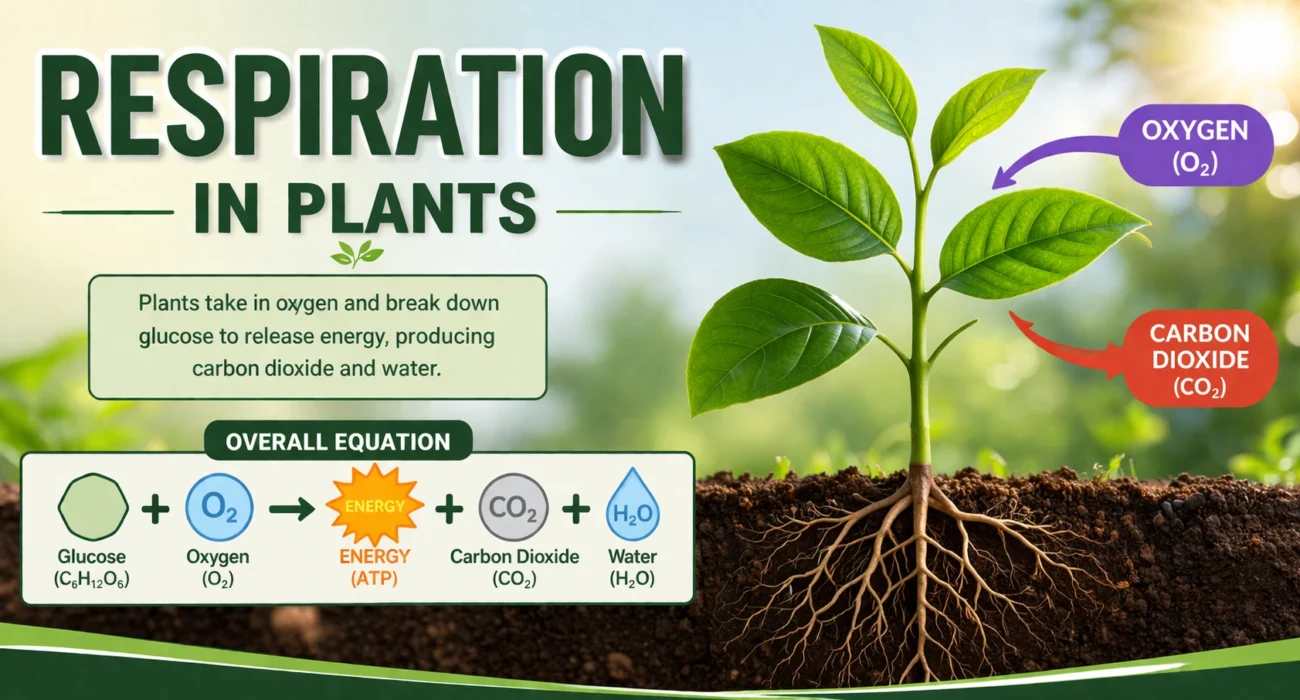
Respiration in Plants for NEET UG 2026: Complete Notes, Tricks, MCQs & Revision Guide
1. MOST IMPORTANT CONCEPTS (NEET DIRECT QUESTIONS)
Definition
Respiration = Oxidation of food → Energy release (ATP)
Occurs in:
- Cytoplasm → Glycolysis
- Mitochondria → Krebs Cycle + ETS
Overall Equation (VERY IMPORTANT)
C_6H_{12}O_6 + 6O_2 \rightarrow 6CO_2 + 6H_2O + Energy
ATP Yield (FREQUENT MCQ)
| Process | ATP |
|---|---|
| Glycolysis | 2 (net) |
| Crebs Cycle | 2 |
| ETS | 34 (net) |
| Total | 38 ATP |
⚠️ NEET Trick: Sometimes they ask theoretical vs actual ATP → Answer: theoretical = 38
Locations (VERY IMPORTANT: MATCH THE FOLLOWING)
- Glycolysis → Cytoplasm
- Krebs Cycle → Mitochondrial matrix
- ETS → Inner mitochondrial membrane
2. GLYCOLYSIS (HIGH WEIGHTAGE)
Key Points
- Occurs in all living organisms
- Anaerobic process
- Glucose → 2 Pyruvate
Important Outputs:
- 2 ATP (net)
- 2 NADH
MOST ASKED POINTS
- First ATP used → Glucose → Glucose6phosphate
- NADH formed at → PGAL → BPGA
MNEMONIC (Steps Memory Trick)
“Goodness Gracious Father Franklin Did Go By Picking Pumpkins to Prepare Pies”
(Glycolysis intermediates sequence)
3. FERMENTATION (VERY SCORING)
Types:
- Alcoholic Fermentation (Yeast)
- Product → Ethanol + CO₂
- Lactic Acid Fermentation
- Product → Lactic Acid (Muscle)
NEET TRAPS:
ATP produced = Only 2 ATP
Occurs in:
- Yeast
- Muscle cells (low O₂)
Important Concept:
- NADH → NAD⁺ regeneration (VERY IMPORTANT MCQ)
4. AEROBIC RESPIRATION
Steps:
- Glycolysis
- Link Reaction (Pyruvate → Acetyl CoA)
- Krebs Cycle
- ETS
Link Reaction (NEET FAVOURITE)
Pyruvate → Acetyl CoA
Releases:
- CO₂
- NADH
5. KREBS CYCLE (VERY IMPORTANT)
Key Outputs (Per Glucose):
- 2 ATP (GTP)
- 6 NADH
- 2 FADH₂
- 4 CO₂
Mnemonic:
“Citrate Is Krebs Starting Substrate For Making Oxaloacetate.”
(Citrate → Isocitrate → αKG → SuccinylCoA → Succinate → Fumarate → Malate → OAA)
6. ETS (ELECTRON TRANSPORT SYSTEM)
MOST SCORING TOPIC
Key Points:
- Location → Inner mitochondrial membrane
- Oxygen = Final electron acceptor
ATP Yield:
- NADH → 3 ATP
- FADH₂ → 2 ATP
NEET TRAP:
Without oxygen → ETS stops → entire respiration stops
7. RESPIRATORY QUOTIENT (RQ)
Formula:
RQ = \frac{CO_2\ released}{O_2\ consumed}
Values:
NEET TRICK:
- RQ < 1 → Fat metabolism
- RQ > 1 → Organic acids
8. MOST COMMON MISTAKES (VERY IMPORTANT)
- ❌ Thinking glycolysis needs oxygen
✔️ It is anaerobic
- ❌ Confusing ATP count (net vs gross)
✔️ Net ATP = 2
- ❌ Forgetting the location of processes
- ❌ Mixing fermentation & aerobic respiration
- ❌ Ignoring NADH role
9. HIGH-YIELD COMPARISON TABLE
| Feature | Aerobic | Anaerobic |
|---|---|---|
| Oxygen | Required | Not Required |
| ATP | 38 | 2 |
| End Product | Co2 + H20(net) | Ethanol/Lactic Acid |
| Total | 38 ATP |
10. SUPER SHORT REVISION TRICKS
- “Glyco = Cytoplasm”
- “Krebs = Matrix”
- “ETS = Membrane”
- “38 ATP = Full respiration”
- “2 ATP = Survival mode”
11. NEET LEVEL ANALYTICAL QUESTIONS
Q1. If oxygen supply stops, which process stops first?
✔️ Answer: ETS
👉 Because O₂ is the final electron acceptor
Q2. Net ATP in fermentation?
✔️ Answer: 2 ATP
Q3. Which step produces NADH in glycolysis?
✔️ Answer: PGAL → BPGA
Q4. RQ = 0.7 indicates?
✔️ Answer: Fat metabolism
Q5. Where is ATP synthase located?
✔️ Answer: Inner mitochondrial membrane
FINAL EXAM STRATEGY
Focus 80/20 Rule:
- Glycolysis → 100% prepare
- ETS → HIGH PRIORITY
- RQ → Direct question
- ATP count → Must revise
LAST MINUTE REVISION (1 LINE)
Glucose → Pyruvate → Acetyl CoA → Krebs → ETS → 38 ATP